
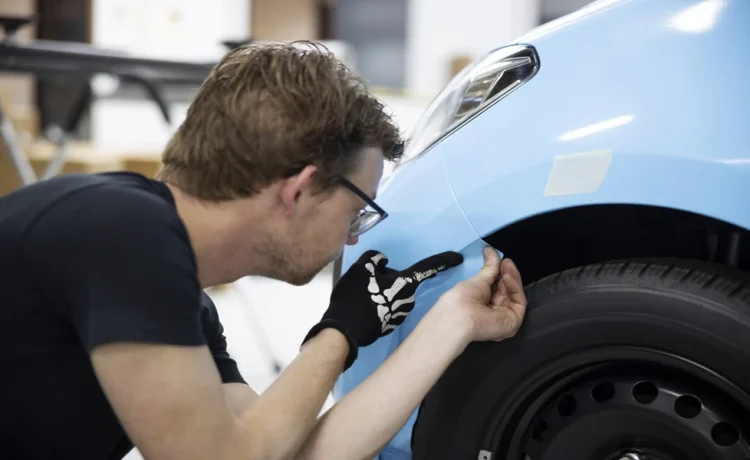
For a proper assessment of the damages that have occurred to the dent in the automobile, it is necessary to make sure about the stability of the structural parts, correct the deformity of the structure, and repaint the surface using the same color combination. The dents that appear on the body of the car give an indication whether the damage is due to the structure or due to the paint seal which leads to water entry and rusting.
If you have to replace your damaged panels, you can learn more about the advanced dent repair techniques that will allow you to keep both the OEM structural integrity and factory paint as they are. This way, when you take care of the small issues now, then you will not have to face the big ones in the future that will be even costlier.
What Is Structural Inspection in Collision Assessment?
Structural inspections are performed in order to inspect the alignment of the unibody or the vehicle frame following a collision in order to ensure that the crumple zones and structural pillars remain mathematically square. Three-dimensional laser measurement tools are used by technicians for comparing hundreds of reference points with OEM measurements.
NHTSA has published their safety test protocol, and among the important points mentioned is that the alignment of the Unibody must be taken care of to maintain the integrity of the passenger compartment and proper deployment of airbags in the event of a secondary collision.
| Step | Action |
|---|---|
| 1. Laser Targets Placed (x,z) | Measure Unibody Coordinates (x,z) |
| 2. OEM Spec Cross-Check | Identify Dimensional Drift |
| 3. Hydraulic Vector Pulling | Restore Structural Alignment |
The hydraulic pulling tower will be applied to align the car chassis in case of deviation greater than 1.5 mm, since bypassing this procedure results in quick wear of tires, inaccurate wheel alignment, and an unstable roof.
How Metal Recovery Restores Panel Geometry
Body panel dents restored to original shape, but at the same time maintaining the body panel’s yield strength. The technician decides whether to go for PDR or metal shaping according to the flexibility of the paint film and stretching of the panel.
DENT IMPACT ASSESSMENT
│
Is factory paint in place?
┌──────────────┴──────────────┐
YES NO
│ │
PAINTLESS DENT REPAIR CONVENTIONAL REPAIR
• Metal massage cold • Removal metal studs
• Glue tab extraction • Body filler & sand
• Zero repainting • Primer & refinish
- Paintless Dent Removal (PDR): Uses various tools like spring steel rods and LED line boards to massage the dent back into place from the backside of the sheet metal, while leaving the paintwork intact.
- Glue Pulling: This method is used when the inner side of the panel cannot be accessed due to reinforcement bars, and high-tensile glue tabs are placed on the outer surface of the panel.
- Controlled Heat/Cold Contraction: Contraction of the panel, stretched too much by the steel or aluminum core of the panel.
Modern Refinishing and Color Matching Processes
When metal reshaping is done, the protective paint is restored by refinishing. Today’s repair shop has computer-based spectrophotometers that can analyze factory painting and create a multi-stage water-based basecoat to match UV weathering and age fading.
| Refinishing Stage | Primary Function | Cure Time (Infrared) |
|---|---|---|
| Etching Primer | Seals and protects metal from moisture and oxidation. | 10 – 15 Minutes |
| Primer Surfacer | Compensates for micro sanding defects and smooths out the surface | 20 – 30 Minutes |
| Waterborne Basecoat | Makes OEM colored pigments and metallic flake orientation. | 15 – 20 Minutes |
| High-Solid Clearcoat | Provides UV protection, scratch resistance, and gloss depth | 30 – 45 Minutes |
After applying the clear coat, blending shall be done on the adjacent panels for the purpose of providing visual consistency in sunlight.
Repair Method Comparison & Decision Matrix
Learn more before taking decision to use either Paintless Dent Repair or traditional refinishing will depend on the degree of the impact, the state of the paint, and the metallurgy of the panels.
Damage Characteristic |
Recommended Technique |
Estimated Repair Time |
Cost Impact |
|---|---|---|---|
The pieces are dings / minor door scuffs. |
Paintless Dent Repair (PDR) |
2 – 5 Hours |
Low |
This medium crease is a shaded paint that has been left intact. |
PDR / Glue Pulling |
1 Day |
Moderate |
Deep Impact (Paint Cracking) |
Metal Pulling & Refinishing |
2 – 3 Days |
Standard |
Structural Frame & Panel Denting |
Frame Alignment + Refinishing |
3 – 5 Days |
Higher |
Frequently Asked Questions
Can all automobile dents be repaired using Paintless Dent Repair technique?
No, Paintless Dent Repair does not work on stretched metal or factory paint that is torn or broken. If the paint’s crack is sharp or the metal’s shape has been distorted then a more traditional metal bodywork and repainting process is necessary.
What are some ways that body shops accurately match faded vehicle paint?
Digital spectrophotometers are used by technicians to precisely measure the exact light reflectance of weathered vehicle panels to match base pigment colors that have been produced by computer software for UV aging.
Will getting a dent repair change my car’s safety rating?
A well-done repair will restore a vehicle back to its original stiffness and panel alignment and will retain all the safety ratings for that vehicle.
What is a typical structural and refinishing repair time?
The time to complete minor PDR repairs is several hours, and complex repairs involving unibody pulling, reshaping panels, and multiple refinishing stages take 3 to 5 business days.
Professional Car Dent Damage Restoration Solutions
Vehicle dent damage expert evaluation ensures both appearance and safety. With laser frame alignment, the use of specialized metal recovery methods, and the refinishing of the clearcoat with precision, your car can be restored to pre-loss condition and retain important resale value.